Years ago, Paul Benson sat down with his two sons for a conversation that would ultimately reshape not only his family’s future but the future of his hometown.
A lifelong cattle producer in Waubun, Minnesota, Benson had built a small butcher operation in Mahnomen County, located on the White Earth Indian Reservation in the northwest corner of the state. The county is one of Minnesota’s poorest and is considered a food desert, with limited access to fresh foods and a shortage of high-paying jobs.
“I told my sons there really weren’t opportunities for small beef producers here,” Benson recalls. “I encouraged them to look elsewhere. I didn’t want them to get stuck.”
But the weight of that conversation lingered. Instead of accepting decline as inevitable, Benson began asking a different question: What would it take to create opportunity here?
From Idea to Initiative
In 2017, Benson and his friend Doyle Turner approached the Minnesota Department of Agriculture (MDA) to explore funding for expanding their family farm’s butcher operation. They learned $10,000 was available for a feasibility study—if they could match it. The White Earth Nation stepped in with matching funds, giving the project momentum.
The feasibility study confirmed what Benson already believed: there was room—and need—for local meat processing capacity. The pair hired a design firm and worked with their accountant to develop a business plan. They pursued additional grants and worked with the Minnesota Department of Transportation to identify an accessible location near both livestock producers and convenient traffic corridors.
Then the COVID-19 pandemic hit. Progress stalled. In September 2021, Turner died from complications related to COVID-19.
“I thought that was the end of it,” Benson says. “The money had dried up, and without Doyle, it felt like we had taken it as far as we could.”
A Second Wind
Nearly a year later, Benson’s sister, Mary Metelak, and her husband, Stew, stepped in and agreed to serve as co-owners. Metelak quickly focused on a pivotal opportunity: a grant from the U.S. Department of Agriculture (USDA) that could revive the project.
To strengthen the application, she turned to AURI. Harold Stanislawski, AURI’s business and industry development director, worked closely with the team to refine the proposal.
“That grant application process was incredibly in-depth,” Metelak says. “AURI helped answer tough questions, which led to a successful application. Harold’s expertise was invaluable.”
Their efforts paid off. The project was awarded nearly $1 million in USDA funding. Bremer Bank provided additional financing, construction began in 2023, and in 2024, Benson + Turner Foods, Inc., officially opened its doors.
A New Model for Rural Meat Processing
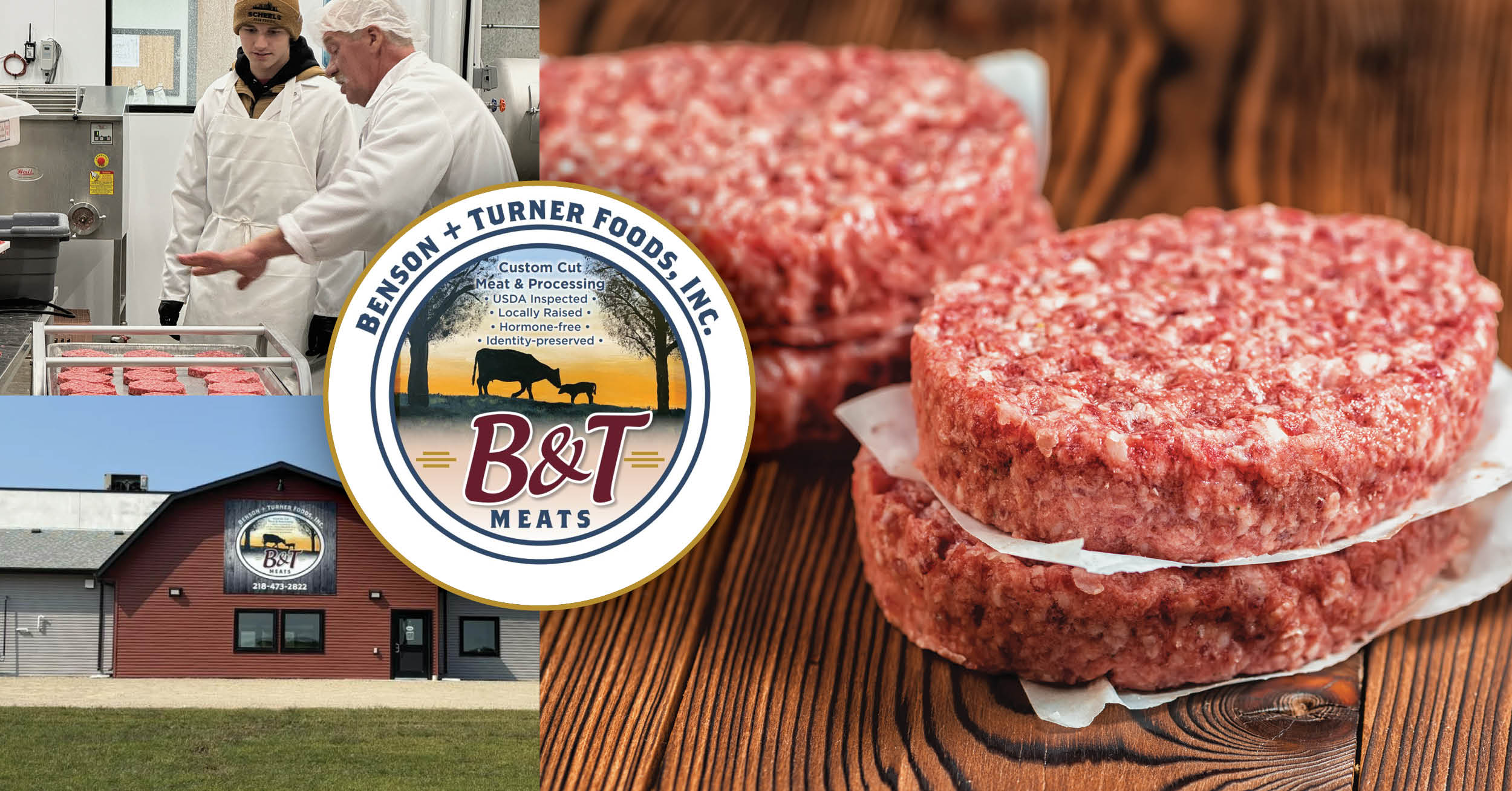
The 8,000-square-foot USDA-inspected facility now employs 21 full- and part-time workers and contributes an estimated $4 million annually to the local economy.
USDA inspection status allows the plant to sell products across state lines—critical for market access. But Benson + Turner Foods operates differently from large-scale commodity processors.
“Everything we sell comes through our door alive and from local producers,” Benson says. “We’re not moving pallets of boxed beef. We have to build a market for every cut. That’s challenging—but it’s also our strength.”
Approximately 40 percent of production goes toward retail and wholesale products, with the remainder custom processing. The company sources livestock from about 15 local producers and assists farmers in developing labels to support direct marketing.
Beyond processing, the facility includes a retail market and a classroom for workforce training and community education. A commercial kitchen and canning space are under construction.
Federal and state partners see the facility as a proof point. Representatives from both the USDA and the MDA have been enthusiastic supporters throughout the lifecycle, Benson says.
“They’ve told us our job is to help rebuild innovation in meat processing—something this country has lost—and demonstrate this model works,” Benson says. “We’re doing our best to prove them right.”
Ongoing Partnership with AURI
Since opening, AURI has continued supporting Benson + Turner Foods with staff training, food safety assistance, and technical expertise.
The business is also participating in AURI’s Benchmarking Service (see sidebar for more information), a data-driven tool that allows processors to compare performance metrics—such as labor efficiency, yield, margins, utilities, and overhead—against peers across Minnesota and the U.S.
“AURI has helped us think more analytically about our business,” Metelak says. “They’ve shown us where we can stretch our dollars and improve efficiency. I can’t say enough good things about their support.”
Stanislawski notes that the project faced numerous moments when it could have collapsed.
“Economic development like this is not for the faint of heart,” he says. “But local meat processing is foundational to rural economies. A plant like Benson + Turner Foods supports livestock producers while also generating secondary benefits for retailers, consumers, and the broader community.”
Keeping the Value Local
Today, Benson and Metelak are focused on strengthening regional markets for local beef and pork. They are advocating for policies and purchasing practices that prioritize local sourcing—encouraging institutions such as food shelves and senior care centers to buy from area producers —so that food dollars remain in the community. They are also working with local school districts and food distribution organizations through the White Earth Tribe to further expand markets for their products.
“We’re learning as we go,” Metelak says. “But we can already see the impact. One of my priorities is to continue to work hard on building awareness to keep the momentum going on the benefits of local sourcing.”
For Benson, the greatest impact is generational. It has been years since he told his sons to look elsewhere for opportunity. Now, he sees young producers launching their own labels, building customer bases, and staying in Mahnomen County. Staying home is not easy, but it is now possible.
“We have young farmers who can start a business, market their own products, and support their families,” Benson says. “That’s the biggest win. Local sourcing isn’t just a slogan—it’s economic development in real time. Now we have to keep it going.”